June 6, 2013

Time for an update.

UPDATE: I felt the need to come back and update this post as we have learned that Audrena's Usher Syndrome diagnosis was a mistake. Here is the post where we learned she does not have Usher Syndrome.

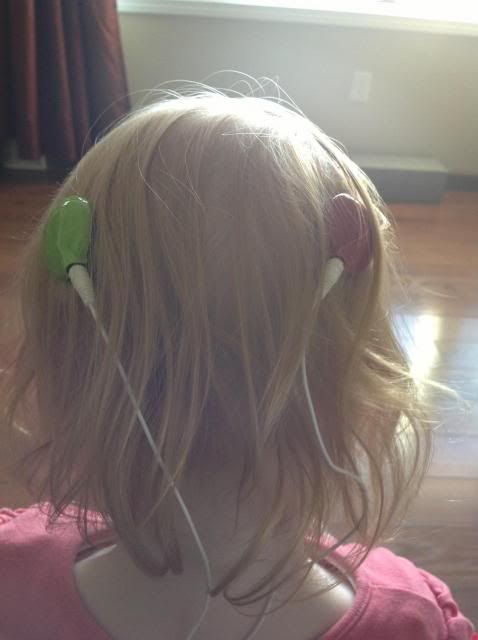
It has been awhile, so I thought it would be a good time to update! We have just been so busy! Audrena is really taking to being bilateral. She knows when the headpiece falls off, and she either puts it back on by herself, or she comes to us and pats her ear to let us know. We do have the alert beep as well, so we usually know before she reaches us. However, we are trying to teach her to be independent with her implants.

We did have some question as to whether she was getting much from the new implant yet since we're still on the first set of programs. Daddy took Audrena to her programming appointment yesterday, and she repeated "bird" to him after he had said it. That was with just the new implant turned on. So it's good to know things are at least starting to sound ok to her. Sometimes it does take awhile for the brain to adapt to the new implant.

They took her into the sound booth, and of course she was just not into it. Audrena rarely cooperates in the booth. She would rather be exploring. Even with that, she did cooperate just enough for them to determine that she is at least at 35-40 decibels with just the new implant on her first sort of generic MAPP, 30-40 with the first implant, and 30-40 with both. Dr. M. from USD has always said (and others have told us as well) that 30-40 decibels is sort of the best expectation for cochlear implant recipients. We do know it's possible to do better. We know plenty of implant patients who hear at 15-25 decibels, and that is our goal for Audrena once she gets old enough to give the Audiologist some verbal information about how she is hearing during programming. Also, we have gotten booth tests with her first implant that showed 20-30. That, combined with what we see at home, are enough for us to believe that she is hearing better than yesterday's test suggests. Both of our Audiologists (Boys Town and USD) have said she could very well be hearing those softer sounds, but she is just not paying enough attention to them to be motivated to turn away from her toy when she hears them.

Also, I forgot to include in some of my previous posts that Audrena heard birds (this was before the second implant)! She heard them before she saw them! We were at the police department's Bike Rodeo at the high school, and there were finches in the rafters of the lunch room. We were eating, and suddenly Audrena looked up (way up) at the birds, pointed, and said, "Tweet tweet!" She had to have heard them because she had not been looking up at all. She was eating. When we first found out that Audrena was deaf, I would take her for a walk, listen to the birds, and wallow in self-pity that my baby girl would never hear those beautiful outdoor sounds like birds chirping. Birds are generally about 15 decibels on the audiogram (although the chart below shows them even softer), so I never expected that she would hear them with implants either. That moment in the high school lunch room was a really defining moment for me, one of those WOW moments that just takes my breath away whenever I think back on it.

Here is an audiogram chart so you can see what I am talking about. The yellow area is the speech banana, or the range that speech sounds fall into.


From firstyears.org


Another little hiccup to report...we may be headed back to the operating room. Yesterday, Dr. M. couldn't find the tube in Audrena's left ear. That's the one Dr. L. inserted in March. Granted, her tools may not magnify quite as much as an ENT's tools, and those tubes are tiny. But she is good, so I trust that if it was there she would have found it. We have an ENT appointment tomorrow morning to check it out. If it's not there, then Dr. L. will need to insert another one. It's such a minor procedure, but it would be the 6th ear surgery and the 7th time under anesthesia for Audrena. And there is always the possibility that she will need a tube in her right ear in the future. So if you are the praying type, say a little prayer that the tube is in place tomorrow, although I don't have much hope that it is. Next week is also our appointment at University of Iowa with the Pediatric Ophthalmologist who will monitor her Usher Syndrome and the doctor with the genetics laboratory that conducted the genetic testing. So please keep Audrena in your prayers that everything turns out well there, too!

On a more positive note, Audrena is really on a role with her speech and language, and she is making progress with her balance! She is saying new words all the time and starting to put them together. She is beginning to understand that there are different words for the same thing, and starting to use them interchangeably. For example, "woof woof," "puppy," and "dog." She also says, "Look at that," or "Look at those." Here are a few of her favorite words/phrases lately.

Look at that/those!
What's that?
Where go? (Where Daddy go?)
Get down!
Good job!/Very good!
NO!
Stop!
Mine!
And when you call her name, she answers with, "What?"
She has also learned "Kelton, "Ana" (for Reyana), and "Zach" (my nephew).

Although we always question whether we could be doing more for her, or whether there is something we are missing, we are so pleased with Audrena's progress!

May 23, 2013

Activation #2

Yesterday was Audrena's second CI activation. We checked in at the doctor's office and had two x-rays to confirm that the implant was in its place. Dr. L. came into the room and had me sit in the exam chair with Audrena on my lap. He was having trouble getting the chair to raise up, so he bent over behind the chair to have a look. Audrena peeked around me and asked, "Where go?" I think Dr. L. just loves to hear the progress! And it sure made Randy and me smile!

Then it was time for Dr. L. to become the bad guy. He used some adhesive remover and took the steri strips off of her incision. It healed beautifully! Things looked good, and he cleared her for activation!

After lunch, we returned to The Lied Center. The activation was actually very anticlimactic this time. Audrena didn't give any exciting responses. However, she did hang in there long enough to give them a full audiogram using both implants. She also surprised us by putting the new CI back on when it got bumped off. She just started putting the first on by herself a little over a month ago. We were so proud, especially given that it was nap time!

And when we were done, some good friends from home were waiting in the lobby for us! They were in Omaha for their own reasons and stopped to say hi. We had some ice cream in the cafeteria and then headed for home with our bilateral girl!


Audrena Goes Bilateral!

The past few weeks have been so busy that I haven't had time for an update. Audrena had her second CI surgery May 13th. The surgery took much longer than anticipated...about 1 1/2 hours longer!

The doctor ran into more scar tissue than he thought she would have. We received an update from the OR nurse that he was going to start the cochleostomy (ok, not sure how to spell that!). Later she called the room to say that he encountered some ossification and was still working on the cochleostomy. I was instantly sick to my stomach. I know that ossification in the cochlea can be a real problem for implantation. We waited awhile longer, all the while praying it would be ok. The nurse came into the room to say the implant was in, and they were testing it. I asked if he got a full insertion, and she said she didn't know. She doesn't get that information. I wondered if she was just dodging bad news.

Finally, the doctor came into the room. He said everything went well, he got a full insertion, and the wave patterns were beautiful. I breathed an enormous sigh of relief and immediately asked about her cochlea. He said it was fine. Puzzled, I asked about the ossification. He explained it was where he had drilled during the first attempt at implantation, and it had grown shut more than he expected. I explained that I must have misunderstood the nurse, and he agreed it would have been a big complication if there had been ossification in the cochlea. Everything went very well, and she did not even have a gusher this time!

It wasn't long, and they brought her to us. Audrena slept a long time, and eventually she started to look uncomfortable. The doctors approved some morphine, and shortly afterward the anesthesiologist and surgeon both stopped in to check on her. They said that with a 4 1/2 hour surgery and the extra "digging around" he had to do, she probably needed that extra dose of morphine to get her over the hump. The surgeon was comfortable releasing us to go to the hotel once Audrena woke up to eat and drink. At least she would be nearby if she needed anything at all. Soon enough, Audrena was devouring some hospital cafeteria meatloaf and apple juice.

We were released around supper time, so we ordered takeout and settled in at the hotel. I gave Audrena a sponge bath to freshen her up, and it was off to sleep for our little princess.

The rest is history. It was an easy...and on to activation!

May 2, 2013

Learning to Deal with Usher Syndrome

 UPDATE: I felt the need to come back and update this post as we have learned that Audrena's Usher Syndrome diagnosis was a mistake. Here is the post where we learned she does not have Usher Syndrome.

We have had our ups and downs in the past month. Usher Syndrome has been a big pill to swallow, and I think those ups and downs are going to just be our normal. The past week has been a little more difficult for me. I think it's because summer is coming. We are starting to talk about camping, swimming, and other sunny activities. Every time I look outside at the sun, I think about the potential damage to Audrena's eyes. Bright light speeds up the progression of Retinitis Pigmentosa.

Sunglasses will always be a standard part of Audrena's life. That's not such a big deal. It's just plain healthier for everyone to wear them. But right now she doesn't have any. The big debate has been whether to order prescription sunglasses or transitions lenses now, or to wait until we see the doctor at University of Iowa. In the meantime, whenever Audrena is playing outdoors I think of those precious eyes. So Randy called University of Iowa and talked to the nurse. He explained that our appointment is not until mid-June. Should we order sunglasses now, or should we wait until she sees the doctor in case she makes a change in the prescription? They did recommend that we wait. Our options are clip-on sunglasses for her regular glasses, or a sun hat with a brim. Although logically good solutions, neither of those seem like fantastic options for us. Wal-Mart told me they don't make clip-ons small enough. I need to check elsewhere to confirm that. And a hat? Well, with a child who will soon have bilateral CIs, I see a huge hassle in the making. It's hard enough to keep one on when she plays with necklaces and hats indoors. Two will be even more difficult. We're not really sure what to do at this point, but we know we want to protect Audrena's retinas as much as possible.

When I look at old photos of Audrena in the first few months, it seems like I am looking in at another person's life from the outside. We were so carefree. Sometimes ignorance is bliss. But regardless of the struggles we are facing now, I am thankful we know now about USH2C because we can be proactive. I am thankful for cochlear implants because they have made a phenomenal difference in Audrena's life, and her future might be very different without them. We don't know what USH2C has in store for her. Retinitis Pigmentosa might be very mild for her. Some people make it into their 40s without any vision loss. Most people don't. Realistically, they might make it to their mid-teens. There might be a cure by the time Audrena needs one. Or there might not be a cure. But what I do know is that at least she will be able to hear, and she will be able to speak.

A friend, Susan, sent me a message last night. She is a fellow CI parent and an amazing mentor. I shared some of my worries with her, and I hope she doesn't mind me sharing what she said. She wrote, "All you can do is take one year at a time. No use carrying that big bag of anxiety too far out." Her advice has always been really great, so when I read that message I decided that I would try my best to do exactly what she said. As for preschool, she said, "The school seems much scarier than it is. You'll figure it out. Just make sure you have good teachers and FM/soundfield. She'll do amazing!" Thanks, Susan! You are wonderful.

1 Year IFSP Update

 UPDATE: I felt the need to come back and update this post as we have learned that Audrena's Usher Syndrome diagnosis was a mistake. Here is the post where we learned she does not have Usher Syndrome.

Monday was our annual IFSP review meeting. The team wrote new outcomes, and I mostly watched. I was a little under the weather with a bad case of laryngitis, and Randy wasn't able to get away from work. Plus, I have said before that the goals are not my strong point. Thankfully, we have some very experienced professionals! Some of the things we will be working on with Audrena in the next year are ling-6 discrimination and using 3 or more words to express her wants and needs. Those things seem pretty simple on the surface, but there are plenty of things to work on behind the scenes that contribute to Audrena's overall success.

We also discussed Usher Syndrome a bit. Audrena has Type 2C, but I think she must be an unusual case. For those who might not be regular readers, Audrena is missing two out of the three semicircular canals in her vestibular system. They just didn't form. So she has poor balance, much like people with Usher Syndrome Type 1. Our Audiologist explained that balance is made up of three components: the vestibular system, vision, and proprioception. Basically, her proprioceptive sense will be all that is left when her vision starts to narrow. Things like gymnastics are actually very good for her because it will help her learn to compensate. Audrena's physical therapist already does a phenomenal job working on balance-related activities with her. He sets up obstacle courses with stairs, uneven surfaces, balance foam, etc. The new physical therapy goals included things like working on walking stairs without a handrail and jumping.

One of Audrena's SLPs asked how Usher Syndrome will affect literacy for Audrena. My answer was that hopefully she shouldn't have to worry about that in the immediate future. The Usher expert that we met with a few weeks ago said that most patients still retain enough central vision to read even at 50 years old. It was a valid topic of discussion, though!

We also discussed the upcoming CI surgery and whether we should expect the new "ear" to fully catch up with the first. Hopefully it will happen, but there are certain milestones (18 months, 24 months, 3 years), and we've already sort of missed two of them with the second CI. With surgery approaching in less than two weeks, we are just praying for a successful implantation and will worry about catching up once that second implant is activated.

Also, we did check out the preschool classroom that Audrena will be in next year. Our Audiologist and SD School for the Deaf Outreach Consultant looked at things like class size, carpeting, wall coverings, curtains, and the presence of a soundfield system. I will fully admit that the idea of transitioning out of Birth to 3 Connections and into the school district scares me. It's unfamiliar territory, and I don't do well with that. So I guess it's a good thing that I have a year to educate myself! And thankfully Audrena has a fantastic team working hard to ensure that she has the best possible learning environment! We are incredibly grateful for every single person on Audrena's team.

April 22, 2013

Our rare flower...

UPDATE: I felt the need to come back and update this post as we have learned that Audrena's Usher Syndrome diagnosis was a mistake. Here is the post where we learned she does not have Usher Syndrome.

"The flower that blooms in adversity is the rarest and most beautiful of all." ~ Mulan

We have always known that Audrena is a rare, beautiful flower. Ok, so we think all three of our kids are perfect, handsome, beautiful little people, but Friday we found out just how genetically rare Audrena really is. At Boys Town, we met with two of the country's top Usher Syndrome researchers. One of them opened up our meeting by explaining that Audrena is one of only 20-25 people in the world diagnosed with Type 2C. That's right. Only 20-25 people in the entire world have been diagnosed with this particular type of Usher Syndrome. He said he has seen half of them, and the next youngest was around 18 years old. It's pretty remarkable that Audrena was diagnosed at two years old.

So what does that mean for us? Well, for starters, they can only tell us what they know, which is not a whole lot considering they have so few people to draw information from. However, they do expect Retinitis Pigmentosa to be mild for her, with night vision loss starting in the late teens and peripheral vision loss starting in the mid-twenties to thirties. If you ask me, "mild" is a relative term, considering that Usher Type 1 patients typically lose their vision at an earlier age and a faster pace. He explained that for them to participate in research studies, they need to have an assistant and usually a guide dog to travel. So I feel like it's all relative because for a "normal" person any vision loss is a big deal. Audrena may someday still need that assistant and that guide dog. It just might happen later in life for her. But we'll take it. Slower is better.

They were able to advise us about some things to protect her retinas, such as sunglasses and transitions lenses for her regular glasses. We asked about high doses of Vitamin A palmitate, but there is a fine line between slowing the retinal degeneration with the supplements and damaging other organs. Ultimately, we'll let the doctors help us navigate that path if it's an option.

We also discussed the genetics of Usher Type 2C. I didn't write down the statistics and can't remember what they told us, but suffice it to say that it was a freak thing for me and Randy to find each other. It's not likely for anyone in our families who happens to be a carrier to ever find a partner who is also a carrier. Likewise, our children should not worry too much. And then that brought us to our next question. Is it ever possible for a person to not have a hearing loss and still have Usher. The answer was that if our other children have normal hearing, then we shouldn't worry about them. Statistically, we have a 25% chance of having a child with Usher. Audrena just hit the jackpot, in more ways than one.

They discussed Audrena's abnormal vestibular system, the way her cochleas are wider at the opening and narrower at the opposite end, and they had reviewed the CT scan and operative report from her CI surgery. It was something new for them. Typically, a Type 2C patient doesn't have a CT scan because they are not diagnosed until roughly their mid-twenties and have only ever needed hearing aids, not cochlear implants. So they were unable to tell us whether any of Audrena's anatomical abnormalities are related to the Usher Syndrome, but they said it might very well be two different things happening to the same person.

Since we received the genetic test results, I have read a lot of news articles regarding research to cure Usher Syndrome and also Retinitis Pigmentosa. Many times I have heard that a cure is probably 10-15 years away. I asked them, "Would it be unreasonable for us to hope for a cure within 10-15 years?" The answer was no. It's not unreasonable at all. There has been progress with gene therapy, and things are moving along faster than what had been generally expected years ago. Plus, the actual research process is getting much less expensive, so they can do more with the funds they have available. One of them told us he expects Audrena to benefit from a cure because she is young, and she has time. She likely has that 10-15 years. That is what I call hope, right from the expert's mouth.

The appointment ended with them asking permission to do a write up for a medical journal about her case. Of course, we agreed because anything that helps the research toward a cure is a benefit.

We left the appointment feeling pretty good. The news was the best we could have hoped for, and our questions have been answered. Plus, they told us that we will be seeing the right doctors at University of Iowa. Audrena will be in good hands. We have hope. And we already know we have a small, mighty, rare flower who certainly IS blooming in the face of adversity.

April 8, 2013

A New Team Member

Last Monday also marked the start of our new Speech-Language Pathologist. She has good experience, and we really like her! Audrena will see her twice weekly, at least until she turns three and transitions to the school district. We feel like she is a great addition to Audrena's team!

We have an IFSP review meeting coming up in a few weeks. I'll be interested to see what kinds of goals Audrena will have in the next 6 months. She had asked me if there were any specific goals that we think Audrena should have. I will be honest and say that it's not our strong point in developing her goals. So we'll work with the professionals and see what we come up with. Audrena really has a great team, and we are comfortable and confident with their knowledge.

We have a date!

 UPDATE: I felt the need to come back and update this post as we have learned that Audrena's Usher Syndrome diagnosis was a mistake. Here is the post where we learned she does not have Usher Syndrome.

On a happy note, we have a date for Audrena's left ear cochlear implant surgery! If all goes as planned, she will have two working "ears" before Memorial Day!

We went to see Dr. L. last week, and he removed the packing material from her ear. Everything looked good, and he said he was ready to schedule the implant surgery.

We talked a little bit with him about the Usher Syndrome diagnosis. It was kind of out of his area of expertise, but his advice was to do whatever we could to protect Audrena's eyes because with her vestibular dysfunction she would need vision to help with her balance. He said the University of Iowa was a great place to be going.

During the appointment, I could tell that Dr. L. was really observing Audrena. She did use a few words. His nurse gave Audrena a sticker with Minnie Mouse and 3 hair bows. She brought it to me, pointed at each bow, and counted 1, 2, 3. Then she peeled the sticker, stuck it on her shirt, and tried to give the paper backing to Randy. He said, "No. Go throw it in the garbage." Audrena walked to where she thought the garbage can should be, under the counter. Dr. L. was sitting there and said something like, "It's not over here." So she turned and went to the other side of the room, where she spotted the wall-mounted garbage can. She stretched as far as she could and pushed the paper into the can. There were no visual cues. She did it all using her receptive language and listening! Yay! Audrena also played with Dr. L. a bit, getting him to put her up and down in the exam chair. Toward the end of the appointment, Dr. L. looked at us and said, "She is a very smart kid." It meant a lot coming from someone who sees children all day long! Yes, we think she is smart, too. I can't wait to see what she can do as a bilateral implant recipient!

Usher Syndrome Type 2C

 UPDATE: I felt the need to come back and update this post as we have learned that Audrena's Usher Syndrome diagnosis was a mistake. Here is the post where we learned she does not have Usher Syndrome.

Last week was hard, to say the least. Monday morning, Audrena had her two year well-check. While Randy was at the doctor with her, he received a call from the geneticist. Audrena's test results had come back. She has Usher Syndrome Type 2C. Our worst fears were realized. For those who are unfamiliar, Usher Syndrome is a deaf-blind genetic condition. It means that Audrena will eventually begin to lose her eyesight to Retinitis Pigmentosa. It will start with night vision loss and progress to loss of peripheral vision, leaving her with only central/tunnel vision. There is no cure.

Thankfully, Randy was at the doctor's office when he received the call. He had the opportunity to sit down with our much-loved family doctor for a heart-to-heart. She is such a wise woman! She said something to the effect of, "Listen to me. When you look at Audrena, don't see the label. SHE is NOT Usher Syndrome. SHE is Audrena. She is your beautiful baby girl, and she will be just fine." She had other things to say, too, but I wasn't there to hear them. Randy left with her home phone number in hand. She had given it to him in case we needed her after hours.

He came right home to tell me the news. It felt like someone literally ripped my heart out. My baby is going to go blind, and I can't stop it. As if being deaf wasn't enough. I cried. Hard. I think it was actually more emotionally taxing for me in those first hours than losing my parents. Sure, losing my parents was pure awful. Those were two of the worst times in my life! I don't want to belittle that at all! But you expect your parents to die at some point. You don't expect your child to be deaf AND blind. I wondered if she will ever drive a car, play sports, get married and have children, if she will do all those things that seeing people take for granted. I started immediately developing a bucket list in my mind of experiences I want her to have before she becomes legally blind: stargaze, walk on the beach, see the ocean, visit the grand canyon, read, read, read, etc.

It did get easier, though. I have said before that if I don't have information and a plan I am lost. So the first thing I did when I could compose myself enough was to e-mail two parents of children with Usher Syndrome. I needed information, and I needed firsthand advice. Thankfully, they were quick to respond with comforting words, resources, and hope.

We learned that Type 2C is one of the most rare and least aggressive types of Usher Syndrome. Of course, it varies from person to person, but the fact that we might have 10-15 good years before Audrena has any vision loss is helpful. There is a wealth of research happening right now, and things look promising. Gene therapy has restored vision in some children with LCA, a form of Retinitis Pigmentosa. And they are in the early stages of clinical trials for Usher Syndrome gene therapy. Other research targeted at RP is also happening. So with any hope, there might be medical advancements in time for Audrena to benefit from them. And we need to have hope.

 In the meantime, our geneticist admitted to Randy that she is not very familiar with Usher Syndrome. But she worked hard to find him the answers to our immediate questions and quickly contacted an expert at the University of Iowa, who directed her to a pediatric ophthalmologist and a pediatric otolaryngologist who, if I understand correctly, is also in charge of the genetic testing. Audrena's genetic testing was done through that lab. Also, from what have read on the internet, the pediatric ophthalmologist specializes in juvenile inherited eye diseases and has been involved in rodent and human molecular trials for retinal disorders. We have been told my several doctors and even some parents that the University of Iowa, and this doctor, are some of the best in the country. So now we are working on getting an appointment set up with them.

We may not be able to beat Retinitis Pigmentosa, but we will sure do whatever we can to slow it down! I have been reading about the use of Vitamin A palmitate, DHA, and Omega-3 to slow down the progression. From what I understand, though, they cannot be used until age 6. But that's something we will ask the doctors about. We will also be looking into Transitions lenses and/or prescription sunglasses for Audrena because the sun's rays have been shown to speed up the progression of RP.

It might also be possible for us to meet with a doctor at Boys Town who works with Usher Syndrome. We should hear something about that in the coming days as well. A friend gave me two e-mail contacts: a person with Usher's and the parents of a child with Usher's. I searched for Usher Syndrome blogs, and I did e-mail a person who has Type 2. Our SD School for the Deaf Outreach Consultant provided me with two contacts as well. When we were getting familiar with cochlear implants, it helped to talk to people who had them, or whose children had them. This is the same situation for us. It is helping to connect with others who are affected by Usher Syndrome. And we will continue to hope and pray for a cure.

March 12, 2013

Cochlear Implant HELP Interview with Stuart McNaughton

Stuart McNaughton is the author of "He Is Not Me," a book about his life as a deaf child and a hearing adult after he chose a cochlear implant. Here is my disclaimer. I just purchased the book, so I have not yet had time to read it, but I will likely come back to give my thoughts when I am done. Implanted adults are giving the book rave reviews.

Click the link below to read the interview.

Cochlear Implant HELP Interview with Stuart McNaughton

Many things that Stuart said in the interview really resonated with me. Also, what his mother said struck a chord. Below is the direct quote from the interview.
What do you think your parents’ advice would be to the parents of deaf children today?
I am laughing at this very question.  In fact, I just called my parents and my mother answered the phone.  I posed this question to her, and this is what she said: get lots of advice, do the research, but don’t delay.  I guess this kind of ties in with the Author’s Message on the He Is Not Me website, in which I state that I honestly didn’t start living until I was twenty-three, the day I got my cochlear implant.
That is exactly what many professionals and implant patients told us when we started the process. We did our best to follow that advice, and I firmly believe it was golden. It's vitally important for a child to be implanted as early as possible, if that is the path that the parents intend to take. Time is of the essence. Today we wish we had known sooner that Audrena was deaf. But as it is, we are thrilled with the progress she has made, and we know in our hearts that we made the right decision for her.

Stuart's book is available via Kindle edition, but you do not need a Kindle to purchase and read it. You can download the Kindle app for PC, or the app for the android phone/tablet. Purchase "He Is Not Me" here. You can also visit Stuart's website or Facebook page.